Digital Twin Technology Transforming Industries Today
Digital Twin Technology is revolutionizing how industries operate by creating virtual replicas of physical systems. This innovative approach allows businesses to simulate, analyze, and optimize processes in real-time, leading to enhanced efficiency and decision-making. As organizations across various sectors adopt this technology, the potential for improved performance and predictive insights is becoming increasingly evident.
From manufacturing to healthcare, digital twins are not just theoretical concepts but practical tools that demonstrate significant real-world applications. By integrating Internet of Things (IoT) devices and advanced analytics, digital twin systems provide a comprehensive view of operations, enabling organizations to make proactive adjustments and innovations.
Introduction to Digital Twin Technology

Source: tech-wonders.com
Digital Twin Technology represents a groundbreaking innovation that creates a virtual replica of a physical object or system, allowing for enhanced monitoring, analysis, and optimization. Its significance lies in the ability to simulate real-world scenarios, facilitating better decision-making processes across various industries. By harnessing real-time data, organizations can predict outcomes and improve operational efficiencies, thus transforming the way industries function.At its core, the creation of digital twins is based on several fundamental principles, including the integration of data from sensors, advanced analytics, and simulation models.
These components work together to mirror the performance of their physical counterparts in a digital format. This dynamic modeling enables continuous updates, ensuring that the digital twin remains an accurate representation throughout the lifecycle of the product or system. The combination of IoT (Internet of Things) technologies and cloud computing further enhances the capabilities of digital twins, making them integral to modern digital transformation efforts.
Industries Utilizing Digital Twin Technology
Numerous sectors are actively leveraging digital twin technology to optimize processes and innovate products. Here are some key industries benefiting from this technology:
- Manufacturing: Companies use digital twins to simulate production processes, identifying bottlenecks and improving efficiency. For example, General Electric employs digital twins to monitor the performance of wind turbines, resulting in optimized maintenance schedules.
- Aerospace: The aerospace industry utilizes digital twins for the design and maintenance of aircraft. Boeing, for instance, creates digital models of aircraft components to predict wear and performance issues, enhancing safety and reliability.
- Healthcare: In healthcare, digital twins can model patient anatomy, allowing for personalized treatment plans. Siemens Healthineers has developed digital twins of medical devices to predict equipment failures and streamline servicing.
- Smart Cities: Urban planners are implementing digital twin technology to create dynamic models of city infrastructures, enabling better resource management and urban development strategies. Cities like Singapore are at the forefront, using digital twins for traffic management and environmental monitoring.
Digital Twin Technology has the potential to revolutionize industries by providing real-time insights and predictive analytics, ultimately enhancing decision-making and operational efficiency.
Components of Digital Twin Systems
Digital twin technology consists of several integral components that work together to create a virtual representation of physical systems. Understanding these components is essential for leveraging the full potential of digital twins in various applications, from manufacturing to urban planning. Each part plays a crucial role in ensuring real-time data accuracy and system functionality.The key components that comprise a digital twin system include sensors, data analytics, connectivity, and user interfaces.
These elements collaborate to provide a seamless flow of information, enabling businesses to monitor, analyze, and optimize their operations effectively.
Key Components Overview
Each component of a digital twin system has a specific function that contributes to its overall effectiveness. The interplay between these components allows for real-time updates and improved decision-making processes. Below is a summary of the major components and their roles:
| Component | Role |
|---|---|
| Sensors | Collect real-time data from physical assets, providing essential input for the digital twin model. |
| Data Analytics | Processes and analyzes the data collected to generate actionable insights and predictions. |
| Connectivity | Ensures seamless communication between physical assets and their digital counterparts, often facilitated through IoT technologies. |
| User Interfaces | Provides dashboards and visualizations for users to interact with digital twin data, enhancing decision-making and strategy formulation. |
Integration of IoT Devices with Digital Twin Technologies
The integration of Internet of Things (IoT) devices is a cornerstone of digital twin systems, as it enables the real-time data collection required for accurate simulations. IoT devices, equipped with sensors, gather data from the physical environment, such as temperature, humidity, and operational metrics. This data is then transmitted to the digital twin, which mirrors the physical object or system.
The synergy between IoT devices and digital twins facilitates predictive maintenance, where analytics can forecast potential failures before they occur. For instance, in the manufacturing sector, a digital twin of a machine can use IoT data to predict when maintenance is needed, thereby minimizing downtime.
“The fusion of IoT and digital twin technologies transforms raw data into valuable insights, empowering organizations to optimize performance and reduce operational costs.”
The real-time capability of IoT devices feeds directly into the digital twin model, ensuring its accuracy and relevance. This integration exemplifies how digital twins are not just static representations but dynamic entities that evolve with the physical world they simulate.
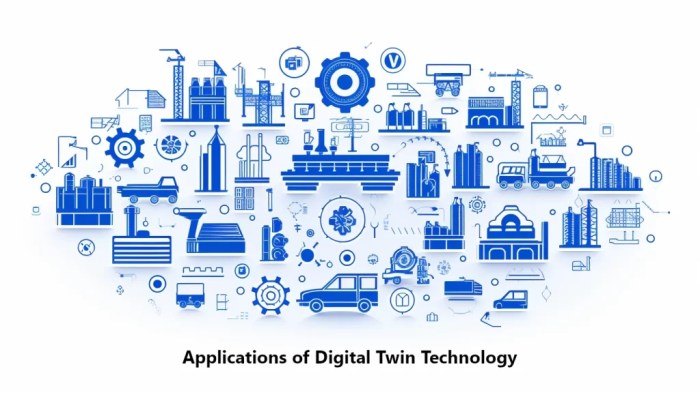
Applications of Digital Twin Technology

Source: idei.club
Digital Twin Technology is making waves across various industries, providing innovative solutions that enhance operational efficiency, improve decision-making, and foster sustainability. By creating a virtual replica of physical assets or systems, organizations can monitor and analyze performance in real-time, leading to significant advancements in multiple sectors.
Manufacturing Applications
In the manufacturing sector, digital twins are employed to streamline processes, predict equipment failures, and optimize production lines. For instance, General Electric uses digital twin models of gas turbines to monitor performance and predict maintenance needs, significantly reducing downtime and maintenance costs. By utilizing real-time data, manufacturers can adapt to changing market demands and enhance product quality.The key benefits of implementing digital twins in manufacturing include:
- Increased operational efficiency through real-time monitoring and analytics.
- Enhanced product quality by simulating various production scenarios before implementation.
- Reduced maintenance costs due to predictive maintenance capabilities.
- Improved supply chain management by visualizing the entire production process.
Healthcare Applications
In healthcare, digital twin technology is revolutionizing patient care and operational efficiency. Hospitals and medical facilities leverage digital twins to simulate patient outcomes and optimize healthcare delivery. For example, a hospital in Singapore created a digital twin of its entire facility, allowing staff to improve patient flow and resource allocation, which led to faster treatment times and improved patient satisfaction.The advantages of digital twins in healthcare include:
- Personalized medicine through the simulation of treatment responses based on individual patient data.
- Enhanced patient monitoring and management by tracking health metrics in real time.
- Improved operational efficiency within healthcare facilities through better resource management.
- Data-driven insights that lead to better patient outcomes and lower healthcare costs.
Urban Planning Applications
Digital twin technology is also transforming urban planning by providing city planners with a dynamic model of urban environments. Cities like Singapore and Amsterdam have created digital twins to simulate urban dynamics, allowing for better planning of infrastructure and services. These digital models help in visualizing the impact of new developments, optimizing traffic flow, and planning for sustainable energy use.The benefits of using digital twins in urban planning encompass:
- Enhanced decision-making through data visualization and scenario modeling.
- Improved public engagement by showcasing urban developments and their impacts.
- Better resource allocation and management of city services, such as waste and energy.
- Increased sustainability by modeling environmental impacts and optimizing land use.
The following companies are notable for their innovative use of digital twin technology:
- General Electric – Pioneering digital twins in manufacturing and energy sectors.
- Siemens – Using digital twins for smart infrastructure and manufacturing solutions.
- IBM – Leveraging digital twins in healthcare for patient management and operational efficiency.
- Cityzenith – Focused on digital twin technology for urban planning and sustainable city development.
- Microsoft – Providing platforms for creating digital twins across various industries.
Benefits and Challenges of Digital Twin Implementation: Digital Twin Technology
Digital twin technology is revolutionizing the way organizations operate by enabling them to create virtual replicas of physical assets. This innovation brings a myriad of advantages, especially in the areas of predictive maintenance and operational efficiency. However, the implementation of digital twins also presents several challenges that organizations must navigate. Understanding both sides of the equation is crucial for successful integration.The benefits of using digital twins extend beyond mere visualization; they significantly enhance predictive maintenance practices and improve overall operational efficiency.
By continuously monitoring and analyzing data from physical assets, digital twins facilitate timely insights that help organizations anticipate failures before they occur. This proactive approach not only minimizes downtime but also optimizes resource allocation, thereby reducing operational costs.
Advantages and Challenges
Understanding the contrast between the advantages and challenges of digital twin technology is essential for organizations planning to adopt this innovation. Below are key points that Artikel these aspects:
The following list summarizes the primary benefits and challenges associated with digital twin implementation:
- Benefits:
- Enhanced predictive maintenance capabilities lead to reduced unplanned downtime.
- Improved operational efficiency through real-time monitoring and data analysis.
- Cost savings from optimized resource allocation and reduced maintenance costs.
- Better decision-making supported by data-driven insights and simulations.
- Increased innovation potential by enabling rapid prototyping and testing of new ideas.
- Challenges:
- Initial high costs associated with implementation and setup.
- Complex data integration from various sources and systems.
- Need for specialized skills and knowledge to develop and maintain the digital twin.
- Data security and privacy concerns related to sensitive information.
- Resistance to change within organizations, impacting adoption rates.
“Digital twins not only help predict maintenance needs but also unlock new levels of efficiency and innovation.”
Future Trends in Digital Twin Technology
As digital twin technology continues to evolve, it is becoming increasingly integral to various sectors, paving the way for innovative applications and advancements. The convergence of digital twins with cutting-edge technologies such as artificial intelligence (AI) and machine learning (ML) is set to redefine operational efficiencies and decision-making processes. This section explores the emerging trends within digital twin technology, particularly focusing on the influence of AI and the prospective integration of digital twins in smart cities.
Emerging Trends and Innovations
The field of digital twin technology is witnessing significant innovations that enhance its applications across industries. Notable trends include:
- AI-Driven Analytics: The integration of AI algorithms enables real-time data analysis, facilitating predictive maintenance and optimized performance of physical assets.
- Interoperability and Standardization: Efforts towards standardizing digital twin frameworks enhance interoperability across different systems, allowing for seamless data exchange.
- Increased Use of IoT Sensors: The proliferation of IoT devices enriches the data fed into digital twins, providing more accurate simulations and insights.
- Decentralized Digital Twins: The rise of blockchain technology fosters decentralized digital twin solutions, enhancing data security and authenticity.
- Real-time Collaboration: Enhanced collaborative features enable multiple stakeholders to interact with digital twins simultaneously, improving collective decision-making.
Impact of Artificial Intelligence and Machine Learning
Artificial intelligence and machine learning are set to transform the capabilities of digital twins. By employing sophisticated algorithms, digital twins can evolve from static models into dynamic systems that learn and adapt over time. This evolution supports various operational enhancements:
Predictive Maintenance
AI systems analyze historical data from the digital twin to predict failures before they occur, minimizing downtime and maintenance costs.
Scenario Simulation
ML models can simulate numerous scenarios based on different variables, helping organizations to plan effectively and make informed decisions.
Enhanced Decision Support
With AI-driven insights, stakeholders can visualize potential outcomes and mitigations, improving strategic responses to challenges.
“The synergy between digital twins and AI heralds a new era of operational excellence.”
Integration of Digital Twins in Smart Cities
The future vision for smart cities increasingly incorporates digital twins as core components of urban management and development. Consider a scenario where a city deploys digital twins to manage its traffic system. In this scenario, a digital twin of the city’s traffic infrastructure is continuously updated with real-time data from sensors embedded in roads and vehicles. It simulates traffic flow, monitors vehicle density, and predicts congestion points.
By integrating AI, the system can analyze patterns in traffic behavior and adjust traffic lights dynamically to optimize flow, reducing travel time and emissions. Additionally, city planners can visualize the impact of proposed infrastructure changes before implementation, allowing for data-driven decisions that benefit urban development. In this interconnected environment, citizens access information about commute times and alternative routes via mobile applications, further enhancing the quality of urban life.
The combination of digital twins, AI, and real-time data will not only improve traffic management but also foster sustainable urban growth, making cities smarter and more responsive to the needs of their inhabitants.
Digital Twin Technology in Research and Development

Source: datanext.ai
Digital Twin Technology plays a crucial role in enhancing the research and development (R&D) landscape across various industries. By creating virtual replicas of physical entities, organizations can simulate, analyze, and optimize their products and processes before actual implementation. This technology fosters innovation, reduces time-to-market, and enhances product quality through informed decision-making and risk assessment.Digital twins accelerate R&D processes by providing real-time insights and data analytics, allowing researchers to test hypotheses, validate designs, and predict outcomes without the high costs associated with physical prototypes.
By integrating digital twins into product lifecycle management, organizations can establish a continuous feedback loop that informs every phase of the product development process, from concept to decommissioning.
Role of Digital Twins in Product Lifecycle Management
Digital twins enable a comprehensive view of the product lifecycle, facilitating better management and optimization of each stage. They allow teams to track performance data, monitor operational conditions, and conduct predictive maintenance. This not only enhances product reliability but also leads to significant cost savings throughout the lifecycle.The following table illustrates how digital twins can transform the R&D process:
| Phase | Traditional Approach | Digital Twin Approach |
|---|---|---|
| Concept Design | Static models and sketches | Dynamic simulations with real-time data |
| Prototyping | Physical prototypes and testing | Virtual prototypes and iterative testing |
| Testing | Limited testing scenarios | Comprehensive testing with multiple variables |
| Production | Fixed production processes | Adaptive production based on digital feedback |
| Maintenance | Scheduled maintenance | Predictive maintenance based on real-time monitoring |
| End-of-Life | Final disposal or recycling | Data-driven decommissioning and recycling options |
Incorporating digital twins into R&D not only streamlines the development process but also fosters innovation and sustainability by minimizing waste and maximizing efficiency. As industries continue to evolve, the integration of digital twin technology will be essential in driving forward-thinking solutions and maintaining a competitive edge in the market.
Best Practices for Developing Digital Twin Solutions
Developing effective digital twin solutions requires a strategic approach that encompasses several essential steps. Organizations must prioritize clear objectives and integrate advanced technologies while fostering collaboration among various stakeholders. By adhering to best practices, companies can achieve greater efficiency, optimize their operations, and harness the full potential of digital twin technology.
Establishing a successful digital twin solution hinges on ensuring data quality and timeliness. Quality data underpins the accuracy and reliability of the digital twin, leading to actionable insights. Furthermore, timely data collection and updates are crucial for maintaining the relevance of the digital twin in real-time scenarios.
Essential Steps for Developing Digital Twin Solutions, Digital Twin Technology
A methodical approach is vital for successful digital twin development. The following steps Artikel the essential elements organizations should consider:
- Define Objectives: Clearly Artikel the goals of the digital twin, whether it’s for predictive maintenance, process optimization, or product development.
- Assess Data Requirements: Identify the necessary data inputs, including sensor data, historical performance metrics, and environmental conditions.
- Choose the Right Technology: Select appropriate tools and platforms that support the integration of various data sources and enable real-time processing.
- Design the Model: Create a detailed model that accurately represents the physical counterpart, ensuring it encompasses all relevant parameters and behaviors.
- Implement Data Management Strategies: Develop robust data governance protocols to maintain data integrity, security, and accessibility.
- Iterate and Improve: Continuously refine the digital twin based on feedback and evolving business needs, ensuring it remains aligned with organizational goals.
Importance of Data Quality and Timeliness
The efficacy of a digital twin largely depends on the quality and timeliness of the data it utilizes. High-quality data ensures that the digital twin delivers accurate insights and predictions. Organizations should implement stringent data validation processes to filter out noise and inaccuracies. Furthermore, real-time data feeds are essential for the digital twin to reflect the current state of the physical system, enabling timely decision-making and proactive interventions.
“Accurate and timely data is the lifeblood of an effective digital twin.”
Role of Cross-Disciplinary Collaboration
Successful digital twin projects often depend on collaboration among various disciplines. Engaging experts from engineering, data science, IT, and business management fosters a holistic approach to digital twin development. This collaboration ensures that diverse perspectives are integrated, leading to innovative solutions that address complex challenges.
- Enhanced Problem-Solving: Cross-disciplinary teams can leverage their unique expertise to identify and resolve issues that may arise during development.
- Increased Innovation: Collaboration encourages the exchange of ideas, driving creative solutions and advancements in technology.
- Streamlined Implementation: A unified approach facilitates smoother project execution, as team members work towards shared objectives and understanding.
- Improved Stakeholder Engagement: Including diverse stakeholders ensures that the digital twin aligns with the needs and expectations of all relevant parties.
Conclusion
In conclusion, Digital Twin Technology stands at the forefront of industrial advancement, offering a blend of innovation and practicality. As we move towards an increasingly interconnected world, the continuous evolution of digital twins will undoubtedly lead to transformative changes across multiple sectors. Embracing this technology will help organizations not only to stay competitive but also to pioneer new possibilities in efficiency and sustainability.
Frequently Asked Questions
What is a digital twin?
A digital twin is a virtual model of a physical object or system that simulates its functions and behaviors in real-time.
How does digital twin technology work?
Digital twin technology works by integrating data from physical assets with advanced analytics and simulation tools to create a dynamic representation.
What industries benefit most from digital twins?
Industries such as manufacturing, healthcare, and urban planning benefit significantly from digital twin technology by enhancing operational efficiency and predictive maintenance.
Are there any security concerns with digital twin technology?
Yes, security concerns exist, particularly regarding data privacy and the potential for cyberattacks on interconnected systems.
How is AI influencing digital twin technology?
AI enhances digital twin technology by enabling predictive analytics, automating processes, and improving decision-making through advanced algorithms.